


Enhanced rock weathering changes cropland soil physical properties and carbon dioxide emissions | Science Societies Skip to main content

Enhanced rock weathering changes cropland soil physical properties and carbon dioxide emissions
February 13, 2026
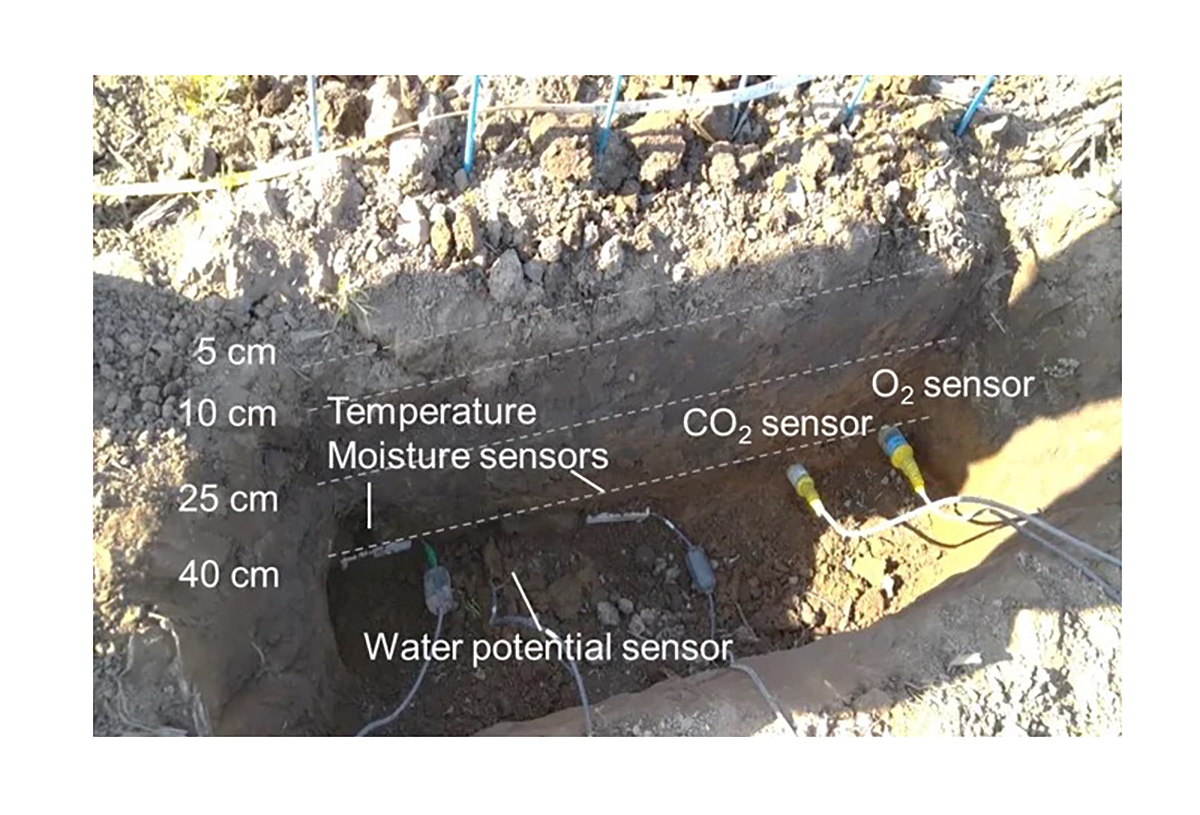
Field installation of soil sensors used in the study. Monitoring of CO₂, O₂, soil moisture, temperature, and water potential was done at multiple depths in a basalt-amended soybean field. Photo courtesy of Yan Zhu.

Crushed silicate rock amendments are being added to croplands as an enhanced rock weathering (ERW) strategy for carbon dioxide removal, but field results remain difficult to interpret. In agricultural soils, CO₂ concentrations and fluxes vary rapidly with soil moisture and pore structure, complicating evaluation of ERW performance.

To address this challenge, researchers conducted a basalt-amended soybean field experiment in Hokkaido, Japan, combining continuous soil CO₂ sensor observations with measurements of soil physical properties related to water and gas movement.


Crushed silicate rock amendments are being added to croplands as an enhanced rock weathering (ERW) strategy for carbon dioxide removal, but field results remain difficult to interpret. In agricultural soils, CO₂ concentrations and fluxes vary rapidly with soil moisture and pore structure, complicating evaluation of ERW performance.

To address this challenge, researchers conducted a basalt-amended soybean field experiment in Hokkaido, Japan, combining continuous soil CO₂ sensor observations with measurements of soil physical properties related to water and gas movement. Basalt incorporation (150 t ha⁻¹) compacted surface soils and increased water retention while the relationship between air content and gas diffusivity remained largely unchanged, suggesting that the soil’s main air-conducting pore network was preserved.

The team then used depth-resolved CO₂ concentration profiles together with gas diffusivity estimates to calculate CO₂ fluxes and to capture rainfall-driven carbon dioxide pulses. Continuous CO₂ sensing revealed transient, depth-specific concentration changes associated with soil moisture dynamics. Under basalt application, CO2 fluxes also tended to be higher.

This approach highlights how integrating continuous CO₂ sensing with soil physical measurements provides a richer and more reliable picture of field-based assessments of ERW performance.


Text © . The authors. CC BY-NC-ND 4.0. Except where otherwise noted, images are subject to copyright. Any reuse without express permission from the copyright owner is prohibited.