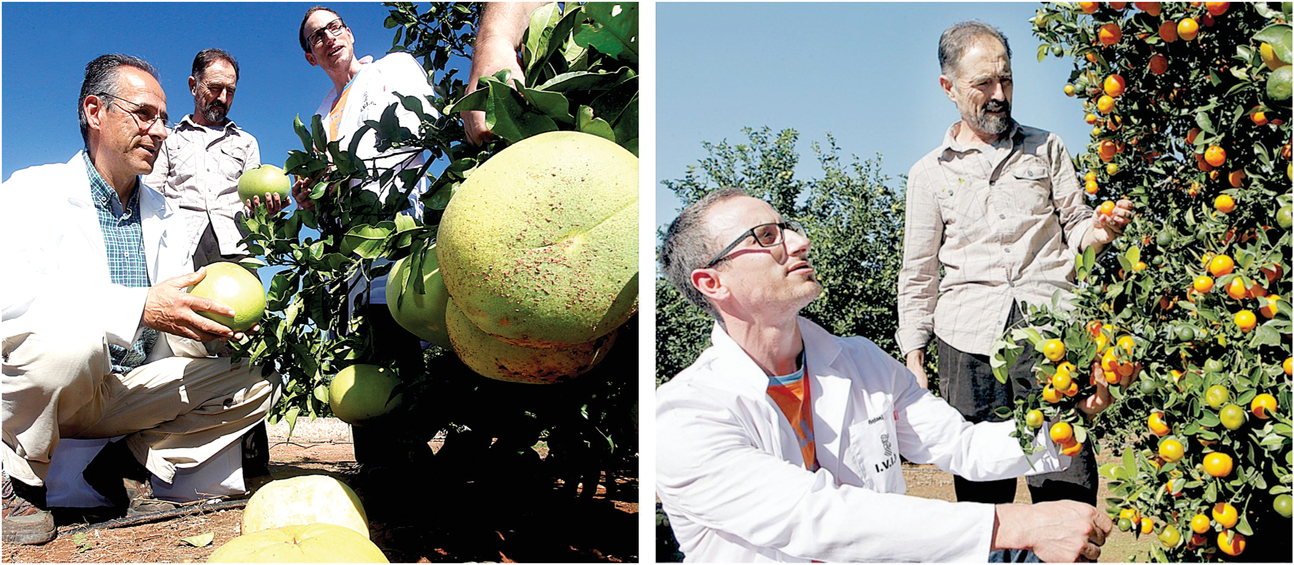

Tracing the evolution and domestication of citrus fruits

The ancestral citrus inhabited the foothills of the Himalayas during the late Miocene global cooling about eight million years ago—then, it immediately diversified into a rapid radiation. How the current enormous citrus diversity was achieved is a question that remains unanswered. In contrast to the appealing, seedless, and tasteful fruit of edible citrus, wild pure citrus mandarins, for instance, bear inedible, small, distasteful, acidic, and seedy fruit.
A series of two articles in The Plant Genome provide original insights on these questions. The researchers performed comparative genomic analyses on wild and domesticated citrus, showing that the abundance of pectins, terpenoids, and flavonoids characterizing citrus fruit were the result of large expansions of pivotal gene families. Interestingly, domestication removed genes involved in the biogenesis of distasteful compounds and affected genes associated with the regulation of citric acid, increasing palatability. Other key genes were highly conserved in stretches of pure mandarin regions, such as the apomictic reproduction gene that allowed huge dispersion of the edible genotypes.
These results support the idea that some genes that naturally evolved in citrus later became potential targets of domestication and that the pervasive adaptive evolution that citrus shows may be in part responsible for the phenotypic differences observed among current species.
Dig Deeper
Gonzalez-Ibeas, D., Ibanez, V., Perez-Roman, E., Borredá, C., Terol, J., & Talon, M. (2021). Shaping the biology of citrus: I. Genomic determinants of evolution. The Plant Genome. https://doi.org/10.1002/tpg2.20104 and Gonzalez-Ibeas, D., Ibanez, V., Perez-Roman, E., Borredá, C., Terol, J., & Talon, M. (2021). Shaping the biology of citrus: II. Genomic determinants of domestication. (2021). The Plant Genome. https://doi.org/10.1002/tpg2.20133
Text © . The authors. CC BY-NC-ND 4.0. Except where otherwise noted, images are subject to copyright. Any reuse without express permission from the copyright owner is prohibited.